



Quick Answer
Listing your business in the wrong metro region can reduce local search visibility by up to 70% for customers outside your primary city. Businesses in Chesterfield, Clayton, and O'Fallon frequently miss nearby customers by targeting only St. Louis City in their directory profiles. St Louis Near Me Directory, a professional services platform across MO, IL, connects businesses with searchers throughout the bi-state metro area using geographic radius targeting. Updated March 2025.
Why Does Targeting Only St. Louis City Miss So Many Customers?
Businesses that list only "St. Louis" as their service area lose visibility with 60% of metro searchers located in surrounding communities. The greater St. Louis metropolitan region spans two states and dozens of municipalities. Someone searching "accountant near me" from Chesterfield won't see results optimized only for downtown St. Louis.
This happens because search algorithms use geographic radius targeting (matching results to the searcher's actual location) rather than broad city names. A business in Maryland Heights might serve clients throughout Clayton, Ballwin, and even Belleville, Illinois. But if the directory listing says "St. Louis," the algorithm doesn't know that.
The fix isn't complicated. You need directory profiles that specify your actual service radius across MO, IL—not just your headquarters city. Learn more about St Louis Near Me Directory and how bi-state coverage works.
What Makes NAP Consistency So Critical for Local Rankings?
Inconsistent NAP data (name, address, phone) across directories causes Google to distrust your location information entirely. When your business name appears as "Smith & Associates" on one platform and "Smith and Associates LLC" on another, search engines treat these as potentially different businesses.
As of March 2025, local pack rankings depend heavily on citation accuracy (how consistently your business info appears across the web). One wrong phone number or outdated address can push you off the first page for "near me" searches.
The practical step? Audit every directory listing quarterly. Check that your street address matches exactly—including suite numbers, abbreviations, and formatting. Businesses across MO, IL often discover they have three different phone numbers listed across various platforms.
This attention to detail shows up in how users experience directory platforms. One reviewer noted the difference immediately:
"Helpful directory connects users with local services efficiently, making it easier to find trusted businesses throughout the St. Louis area."
— Ads Line, Google Review
That efficiency comes from accurate, consistent data powering the search results.
When Does a Bi-State Directory Actually Help Your Visibility?
Bi-state directories matter most when your customers cross the Missouri-Illinois border regularly—which describes most St. Louis metro businesses. Unlike single-city platforms, bi-state directories understand that someone in Belleville, Illinois might hire a contractor based in Kirkwood, Missouri.
The difference shows up in local search intent (what the searcher actually wants based on their query). Someone searching "professional services near me" from O'Fallon, Missouri expects different results than someone in downtown St. Louis. Bi-state directories serve both.
Current 2025 guidelines from Google emphasize hyperlocal relevance. That means showing up for searchers within a 15-mile radius matters more than ranking for a broad city name. St Louis Near Me Directory covers approximately 250 business categories specifically designed for this regional approach.
What Should You Check Before Committing to Any Directory?
The three things that separate useful directories from wasted money: service area granularity, profile optimization features, and domain authority. Not every directory deserves your time or listing fee.
Service area granularity means the platform lets you specify exactly which communities you serve—not just a single city. Profile optimization features include SEO-optimized descriptions, category assignments, and media galleries. Domain authority (a measure of how much search engines trust the website) determines whether your listing actually helps your rankings.
5-star reviewers consistently mention the difference good directory tools make. One user described the experience this way:
"Lane is the best. Extremely attentive and detailed in everything he does. He will treat your account with the care and attention it deserves to ensure you get the best results. highly rated all the way!!!"
— Wade Weistreich, Google Review
That level of attention to individual accounts shows in the search results businesses actually achieve.
Where Can You Find Local Service Across MO, IL?
The St. Louis metro area spans dozens of distinct communities, each with its own search patterns and customer bases. Serving Clayton, Belleville, St. Charles, Ballwin, and nearby Missouri communities requires understanding how each neighborhood searches differently.
Someone in Chesterfield searching for professional services expects to see businesses that explicitly serve their area—not just downtown providers hoping to catch overflow traffic. The same applies to O'Fallon residents, Kirkwood families, and business owners in Maryland Heights.
Regional directories that understand this bi-state reality connect businesses with customers who actually need them. While some platforms focus exclusively on St. Louis City proper, others recognize that the metro economy functions as a single interconnected market spanning both states.
This regional approach shapes how users navigate local search. Multiple 5-star reviews highlight the time savings:
"Easy to navigate resource that quickly showcases relevant local providers, saving time when searching for home, health, or professional services."
— Alec Sabesta, Google Review
When the platform understands geographic context, finding the right provider stops being frustrating.

How Do You Know If Your Current Listings Are Hurting You?
If you're getting calls from the wrong neighborhoods—or no calls at all from areas you serve—your listing geography is the likely culprit. This diagnostic takes about ten minutes.
First, search your own business category from different locations. Use Google Maps on your phone from Chesterfield, then from Clayton, then from Belleville. Do you appear in all three? If not, your service area settings need work.
Second, check your Google Business Profile insights. Look at where your searchers are located. If 90% come from one zip code when you serve a 30-mile radius, something's misconfigured.
Third, audit your directory listings for service area specificity. Platforms that only let you select "St. Louis" are limiting your reach to customers in Ballwin, O'Fallon, and across the Illinois border. The difference between targeting a city and targeting a region determines who finds you.
Ready to fix your bi-state visibility? Contact St Louis Near Me Directory to get your service area configured correctly. For more tactics on improving your local search presence, explore more local business insights from the EyesAI team.
Key Takeaways
- Targeting only St. Louis City ignores 60% of metro-area customers searching in Chesterfield, Clayton, and surrounding communities
- St Louis Near Me Directory helps businesses across MO and IL appear in bi-state search results through geographic radius targeting
- NAP consistency across directories determines whether Google trusts your location data for local pack rankings
- Businesses in Maryland Heights and neighboring towns gain visibility by listing in directories that cover both Missouri and Illinois markets
- As of March 2025, search algorithms prioritize hyperlocal relevance over broad city-level targeting
Frequently Asked Questions
What happens when you list your business in the wrong metro region?
You become invisible to customers searching from outside your listed city. Someone in Chesterfield won't see results optimized for downtown St. Louis. Bi-state directories like St Louis Near Me Directory fix this by letting you specify your actual service radius across MO and IL communities.
How do bi-state directories improve local search visibility?
They recognize that metro economies cross state lines. Instead of limiting you to one city, they let you appear for searches in Clayton, Belleville, O'Fallon, and surrounding areas. This geographic radius targeting matches how customers actually search for services near them.
What is NAP consistency and why does it matter for rankings?
NAP stands for name, address, and phone number. When this information differs across directories, Google distrusts your location data. Inconsistent NAP can drop you from local pack results entirely. Quarterly audits across all platforms prevent this problem.
How long does it take to fix metro region listing mistakes?
The audit takes about an hour. Corrections across major directories take one to two weeks to propagate through search results. St Louis Near Me Directory offers done-for-you profile creation that handles geographic targeting from day one across MO, IL communities.
Which St. Louis metro communities benefit most from bi-state directory listings?
Businesses in boundary communities see the biggest gains. Maryland Heights, Chesterfield, Clayton, and O'Fallon in Missouri plus Belleville and surrounding Illinois towns all benefit. These areas draw customers from both states, making bi-state visibility essential for maximum reach.
Contact St Louis Near Me Directory
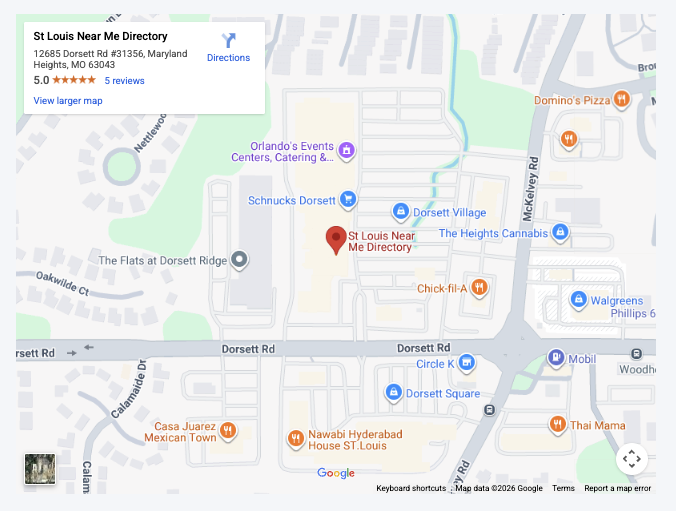
Address: 12685 Dorsett Rd PMB 31356, Maryland Heights, MO 63043
Phone: +13147568500
Website: https://stlouismissourinearme.com


.svg)

%20(1).avif)
.svg)





.svg)











%20(1).avif)
%20(1).avif)